When measuring impact becomes a reflection of who you are—not just what funders require
Let’s be honest: for many nonprofit professionals, the word “evaluation” triggers thoughts of compliance reports, funder demands, and hours spent wrestling with spreadsheets. It feels like something done to the organization rather than for it.
But what if we’ve been looking at this all wrong?
What if evaluation isn’t just a bureaucratic box to check, but one of the most authentic expressions of your organization’s values?
Evaluation as a Mirror of Mission
Nonprofits exist for a singular purpose: to fulfill a social mission. Unlike for-profit businesses measured by revenue and shareholder returns, your success is defined by the change you create in communities and lives. Research confirms this distinction—nonprofit effectiveness must be judged by mission-related outcomes, not financial surplus alone (Ortega-Rodríguez et al., 2020).
This is precisely why evaluation matters so deeply. When done thoughtfully, evaluation answers the most fundamental question any mission-driven organization can ask: Are we actually making the difference we set out to make?
Every data point you collect, every outcome you measure, every story you capture is an opportunity to hold up a mirror to your mission and see if your reflection matches your intentions.
From Compliance to Commitment
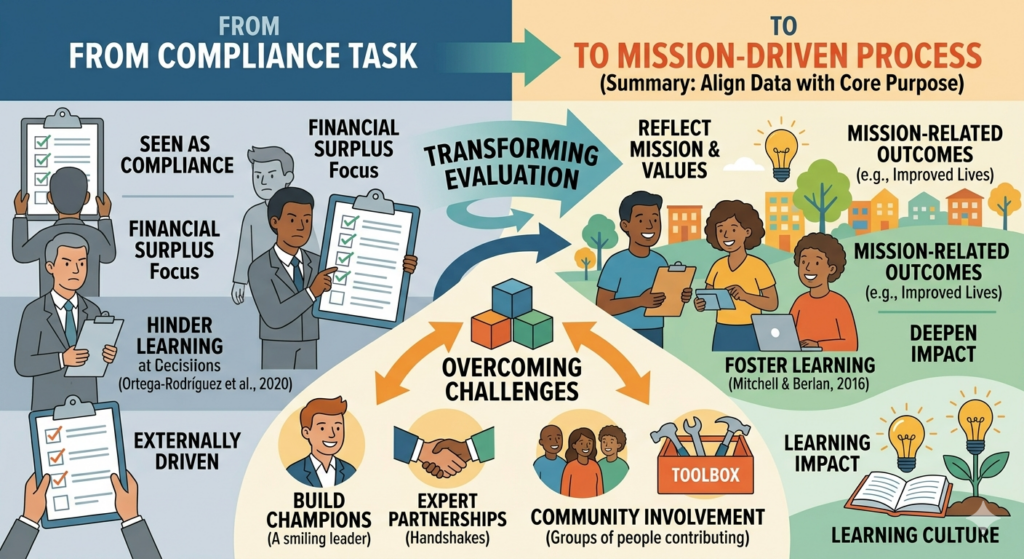
Here’s where many organizations get stuck: they approach evaluation as something imposed from the outside—a requirement to satisfy funders or demonstrate legitimacy. Studies show that when evaluation is purely externally driven, it often feels bureaucratic and can actually impede genuine learning (Mitchell & Berlan, 2016).
The shift happens when organizations recognize evaluation as intrinsically motivated—driven by an authentic desire to improve effectiveness and deepen impact. Organizations that integrate evaluation into their strategic management don’t just report data; they use findings to guide decisions, refine programs, and better serve their communities (Carman & Fredericks, 2010).
Consider the difference:
• Compliance-driven evaluation asks: “What do we need to report?”
• Mission-driven evaluation asks: “What do we need to learn?”
The former satisfies requirements. The latter transforms organizations.
A Covenant with Your Community
When you commit to genuine evaluation, you’re making a promise to the people you serve. You’re saying: We care enough to ask hard questions. We’re humble enough to learn. We’re committed enough to change course if needed.
This commitment manifests in powerful ways:
Transparency builds trust. When organizations openly share their results—successes and struggles alike—they demonstrate accountability that strengthens relationships with donors, partners, and communities (Rorimpandey & Gustomo, 2025).
Data improves targeting. Evaluation helps identify who you’re reaching, who you’re missing, and what approaches work best for different populations (Bach-Mortensen & Montgomery, 2018).
Resources stay aligned with purpose. Rigorous evaluation ensures that funds don’t drift from your social mission, reducing the risk of irresponsible spending and honoring donor intent (Ortega-Rodríguez et al., 2020).
Making It Work: Practical Pathways
Yes, challenges exist. Limited budgets, stretched staff, skills gaps, and resistance to change are real barriers. But organizations are finding ways forward:
• Build evaluation champions who connect data to mission and make the case internally
• Partner with evaluation experts who can provide right-fit systems balancing learning with accountability
• Involve community members in defining success—what matters to them should shape what you measure
• Create learning cultures where data sparks reflection and storytelling, not just reporting
The Invitation
Here’s the truth: evaluation is not separate from your mission work—it is your mission work. Every time you pause to measure, reflect, and learn, you’re honoring the communities you serve and stewarding resources responsibly.
So the next time evaluation feels like a burden, try reframing the question. Instead of asking, “What do we have to measure?” ask, “What would our mission have us learn?”
That shift—from obligation to intention—is where transformation begins.
Your communities deserve more than good intentions. They deserve organizations committed to learning what works, adapting what doesn’t, and being transparent about the journey. That’s the real ‘why’ behind evaluation.
References
Bach-Mortensen, A., & Montgomery, P. (2018). What are the barriers and facilitators for third sector organisations (non-profits) to evaluate their services? A systematic review. Systematic Reviews, 7, Article 13. https://doi.org/10.1186/s13643-018-0681-1
Carman, J., & Fredericks, K. (2010). Evaluation capacity and nonprofit organizations. American Journal of Evaluation, 31(1), 84–104. https://doi.org/10.1177/1098214009352361
Mitchell, G., & Berlan, D. (2016). Evaluation and evaluative rigor in the nonprofit sector. Nonprofit Management and Leadership, 27(2), 237–250. https://doi.org/10.1002/nml.21236
Ortega-Rodríguez, C., Licerán-Gutiérrez, A., & Moreno-Albarracín, A. (2020). Transparency as a key element in accountability in non-profit organizations: A systematic literature review. Sustainability, 12(14), Article 5834. https://doi.org/10.3390/su12145834
Rorimpandey, S., & Gustomo, A. (2025). Transparency and accountability of NGOs in managing corporate social funds. European Journal of Business and Management Research, 10(3). https://doi.org/10.24018/ejbmr.2025.10.3.2325