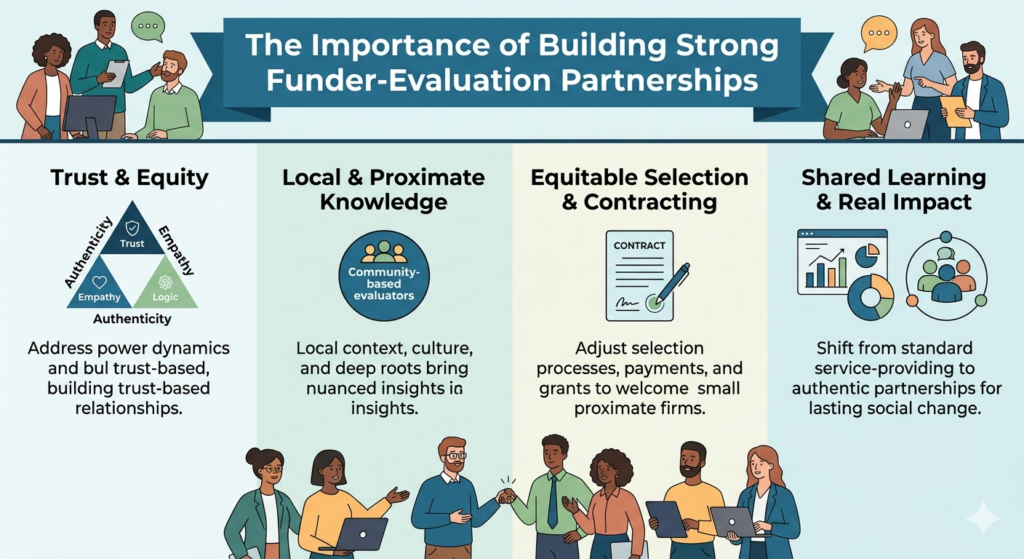
What foundations really look for in evaluation partners and how to build lasting relationships
During our April 2026 Gathering Space, Pedro Paz of Responsive Evaluation Services shared his experience building strong foundation-evaluator partnerships, building on his experience both as a funder (at First 5 Santa Barbara County, the Santa Barbara Foundation, and the Santa Barbara Education Foundation) and as an independent evaluator. His insights reveal what he calls the “hidden curriculum” of working with foundations, the unwritten rules that can make or break professional relationships in our field.
Introduction
Breaking into the world of philanthropic evaluation can feel like trying to crack an unwritten code. How do you get noticed by foundations? What makes some evaluator-foundation partnerships thrive while others fizzle? And once you’re in, how do you navigate the inevitable challenges that arise? In this blog post, Pedro Paz reflects on those questions, and Gathering Space participants add their perspectives.
What do Foundations Actually Value in Evaluation Partners?
When seeking evaluation partners, Paz identified four characteristics that stand out.
- Understanding Context and Politics
Here’s something many evaluators overlook: foundations must publicly respond to your findings. That report you write? Your foundation partner will need to explain it to their board, their donors, and sometimes the broader community.
“Politics includes both internal and external dynamics,” Paz explains. Internal politics means navigating board member expectations and staff relationships. External politics involves managing relationships with donors, elected officials, and community stakeholders.
The takeaway: Before delivering findings, consider how they’ll be received and who will need to respond to them.
2. Complementary Expertise
Foundations aren’t looking for evaluators who duplicate their existing knowledge; they want partners who fill gaps. Paz shares that his long-time evaluator partner specialized in child trauma, an area where he had no expertise.
Ask yourself: What unique value do you bring to the table? This might be:
- Geographic knowledge of underserved areas
- Cultural competency with specific communities
- Technical skills in specialized methodologies
- Entrée into communities the foundation wants to reach
3. Reliability (It’s More Than Just Meeting Deadlines)
Yes, delivering on time matters. But reliability goes deeper than that.
“Documentation means sending post-conversation emails summarizing what was discussed and outlining next steps,” Paz notes. “This creates a clear record and prevents misunderstandings.”
This simple practice, documenting conversations and confirming next steps in writing—builds trust incrementally and protects both parties.
4.Constructive Framing of Results
This is where many technically excellent evaluators stumble. Remember: evaluators don’t have to respond publicly to their findings, foundation partners do.
“Framing matters,” Paz emphasizes. “Constructive criticism that offers pathways forward is more meaningful than harsh judgment.”
How Do You Build Trust Over Time?
Building trust with foundation partners is an incremental process. Paz offered three pieces of advice.
1. Start Small
If you’re hoping to land the biggest contract right out of the gate, recalibrate your expectations.
“This mirrors advice I give to grant seekers,” Paz explains. “If the maximum award is $30,000, don’t apply for the full amount on your first application. Come in at $10,000, deliver excellent work, and build from there.”
The same principle applies to evaluation partnerships. Demonstrate your value incrementally. This could mean providing evaluation-adjacent work, such as a lecture, expert conversation, or small tool-building project that introduces a foundation to your approach and expertise.
2. Be Open to Conversations
Most foundation partners welcome dialogue, don’t hesitate to reach out. But what’s the right balance between persistence and pestering?
The formula: Send an email introducing yourself and your organization, explain what you do, and most importantly, articulate how you can help. Following up is fine, but don’t send something every other day.
Sharing new work, such as a publication, is a good way to demonstrate your expertise. However, if you don’t have a new publication to share, simply ask if they have time for a coffee chat. Keep it informal and friendly.
3. Invest in Mutual Respect
Paz’s partnership with an evaluator he worked with lasted over a decade. What made it work?
“Our evaluator sometimes knew our programs better than I did because she analyzed the data constantly,” he reflects. “But she didn’t always understand the political implications. Mutual respect means acknowledging each other’s expertise and constraints.”
How Do You Put Your Best Foot Forward in Bidding Processes?
Gathering Space participants noted that bidding processes require their own care, offering unique opportunities for evaluators to strengthen their relationships with potential foundation partners.
Honor Bidding Processes’ Constraints
Evaluators need to be mindful of timing and specific legal and cultural constraints. Most types of evaluation commissioners must limit how they interact with potential evaluation partners when in the process of requesting and reviewing project bids. In general, government agencies and bilateral and multilateral donors may be more rigid in their interactions.
Treat Bidding Processes Like Job Applications
This requires doing your homework, as noted below, and learning as much as possible about a foundation and the support they are seeking prior to drafting a proposal or participating in an interview.
Ensure Alignment
By doing your homework and then asking critical questions during the interview process, you can ensure that your values and approaches are aligned with what the foundation is seeking.
Be Honest about Constraints and Offer Alternatives
Foundations value understanding what can be realistically achieved within a project’s timeline and budget. Where bid requests go beyond the timeline and budget provided, propose solutions that might respond to a foundation’s needs within the project’s constraints.
Demonstrate Your Expertise
If permitted, provide reports or other documentation from similar projects you have conducted as tangible evidence of your ability. References who can speak to these examples are also beneficial.
How Do You Shift from “Vendor” to “Thought Partner”?
Gathering Space participants reflected on what it takes to lay the groundwork for long-term relationships, once a contract is signed.
Engage Foundation Partners in the Work
Move away from “siloed” work toward a participatory approach. For example, you can have “data parties” where funders are involved in analysis and sensemaking.
Maintain Consistent and Open Communication
Maintain a consistent communication cadence and be upfront about project constraints as they arise. Foundation partners can make adjustments with sufficient lead time. Last minute surprises, on the other hand, will not be well received.
Find Ways to Share Learning Together Publicly
Find opportunities to co-author findings, co-present at conferences, and focus on shared learnings, rather than just a final report.
How Do You Navigate Common Challenges?
In any relationship, challenges will arise. Paz offered guidance for responding to three.
When You Disagree
Disagreements are inevitable. The question is how you handle them.
“There were times I wanted a report formatted differently,” Paz recalls. “These moments required conversation, not power moves. We worked through compromises, meeting in the middle. The key was ongoing dialogue focused on what best serves the work.”
Shrinking Budgets
You won’t truly know a foundation partners’ flexibility until you have a conversation with them. Some foundation partners have extensive experience with evaluators and can clearly articulate what they want and what they’re willing to pay for. Others are just beginning to think about evaluation.
Pro tip: Offer tiers of services so foundation partners can choose what fits their budget. Bonus: this educates less experienced foundation partners about what evaluators actually do.
For larger organizations, you can review their United States 990 tax forms to see what they’ve paid for evaluation in the past, though this approach is hit or miss.
Timing Pressures
Foundation partners often need data on tight timelines, while evaluators need adequate time for quality work.
The solution? Early communication about dependencies: “If you need this report by June, I need data by April.”
How Do You “Break In” with Foundations?
Some evaluators wonder how to get noticed by foundations in the first place. What does it take to move from being an unknown evaluator to being a known expert and potential partner? Paz offered four pieces of advice, and Gathering Space participants added their insights.
Be Visible
Attend foundation information sessions, community meetings, professional gatherings organized by foundations, conferences, working groups, and networking events. Maintain a presence on LinkedIn through posting and commenting. Make yourself known. The evaluation field, like philanthropy, often operates on “who you know.”
Leverage Existing Relationships
You likely know more people connected to foundations than you realize. Think about evaluators you know who work in different spaces; they may have foundation connections that could benefit you.
Do Your Homework
Before approaching a foundation, understand their evaluation philosophy or framework, their history, values, and previous partnerships. There are four ways to accomplish this:
- Have a conversation with the foundation. Ask what they’re doing for program evaluation, whether their board has questions about impact, and how they currently answer those questions.
- Request insights from peers. Peers who have previously partnered with a specific foundation can offer invaluable insights into the foundation and what it takes to partner with them successfully.
- Review their annual report. This reveals what they’re reporting and at what level of detail.
- Check their website. Look for program evaluation reports that grantees are required to submit. This indicates the foundation’s interest in evaluation and where they are in their journey.
Tool suggestion: Notebook LM can help aggregate information about a foundation and understand them in depth before you reach out.
Be Persistent—But Add Value
The line between persistence and pestering is about what you’re offering. Each contact should provide something useful, not just ask for something.
If unsuccessful the first time, learn from it, improve your approach, and try again.
Gathering Space participants noted that planted seeds may not bear fruit for some time. Evaluators must be patient while waiting for their expertise and skills to match up with a foundation partner’s needs.
What is the Hidden Curriculum in this Type of Relationship?
What separates evaluators who thrive in foundation partnerships from those who struggle? Often, it’s the unwritten rules:
- Deliver on time. Every time.
- Document everything. Follow up conversations with written summaries.
- Be present beyond the final report. Show up for quarterly reviews, check-ins, and relationship maintenance.
- Anticipate needs. Ask yourself: What does this foundation partner need to succeed, and how can I help them get there?
Key Takeaways
- Partnerships are built on trust, communication, and mutual respect. There are no shortcuts.
- Start small, stay consistent, invest in relationships. Prove your value before asking for major commitments.
- Understand the foundation’s world. Know how they’ll use your work and who they’ll need to answer to.
- The expertise you bring matters. Geographic knowledge, cultural competency, and specialized skills can open doors.
- Document, communicate, and follow through. The basics matter more than you think.