If you run a nonprofit, you’ve probably asked yourself at some point: “Is what we’re doing actually working?” It’s an honest question and a brave one. Program evaluation is the structured process that helps you answer it with confidence rather than guesswork.
Yet for many organizations, the words “program evaluation” trigger anxiety. It sounds expensive. It sounds complicated. It sounds like something universities and government agencies do, not small nonprofits juggling limited staff, tight budgets, and urgent community needs.
That assumption is wrong and it may be costing your organization more than you realize.
So, What Is Program Evaluation?
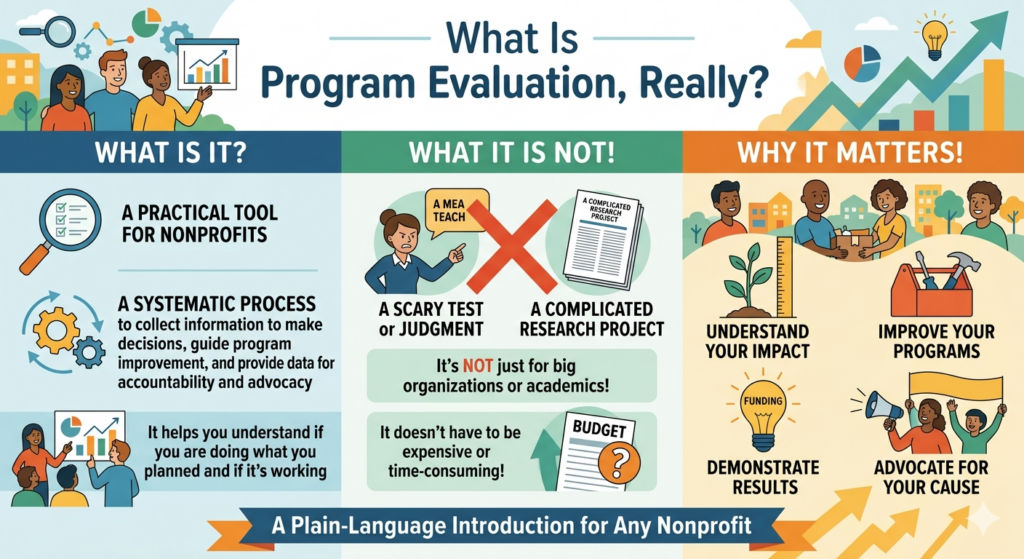
At its simplest, program evaluation is a structured way of asking and answering: “Is our work doing what we think it’s doing, for whom, and at what cost?” (Kazanskaia, 2025). It involves collecting and using information about a program’s activities, results, and impact to improve practice, strengthen accountability, and guide decisions.
The key word is systematic. Unlike informal impressions, “participants seem happy” or “we think it’s going well” evaluation relies on real evidence gathered through straightforward tools like feedback forms, attendance records, interviews, or outcome tracking (Kazanskaia, 2025). It turns your instincts into something you can act on with clarity.
Evaluation isn’t a single thing. It takes different forms depending on what you need to know:
- Formative evaluation helps improve your program’s design before or early in implementation
- Process evaluation checks whether delivery is happening as planned
- Summative evaluation judges overall success at a program’s midpoint or end
- Impact evaluation explores deeper, longer-term change in participants and communities (Kazanskaia, 2025)
You don’t need to do all four at once. You just need to start somewhere.
Clearing Up the Misconceptions
Let’s address the myths that keep nonprofits from embracing evaluation.
Myth 1: Evaluation is only for large organizations.
Not true. Many of the most effective evaluation approaches are specifically designed for small, resource-limited nonprofits. Simple templates, basic indicators, and participatory methods can produce meaningful insights without a dedicated research team or a large budget (Kazanskaia, 2025).
Myth 2: Evaluation is just for funders.
While evaluation certainly strengthens accountability to donors, its greatest value is often internal. It clarifies strategy, surfaces what isn’t working, and helps staff make better decisions day to day (Kazanskaia, 2025; Benjamin et al., 2022). Evaluation serves your mission, not just your grant report.
Myth 3: Evaluation means counting outputs.
Tracking how many people attended a workshop or received a meal is useful — but it’s not enough. Focusing only on outputs can actually misrepresent your program’s true impact (Benjamin, 2021). Real evaluation asks what changed for participants: Did their skills improve? Did their circumstances shift? Did the community benefit in ways you can trace back to your work?
Myth 4: Evaluation is a one-time event.
The most effective evaluation is continuous — an ongoing feedback loop embedded in how your organization operates, not a report you file once and forget (Kazanskaia, 2025).
Why It Matters for Your Nonprofit
The stakes are real. Nonprofits operate in environments where resources are finite, community needs are urgent, and trust must be earned and maintained. Program evaluation directly addresses all three pressures.
When organizations evaluate their programs, they consistently achieve better outcomes. Research drawn from case studies across literacy, health, economic development, and workforce training shows that evaluation findings lead to improved targeting, stronger program content, and more effective delivery (Kazanskaia, 2025). Evaluation doesn’t just measure success — it actively drives it.
Evaluation also builds the kind of credibility that sustains organizations over time. Transparent, evidence-based reporting strengthens trust with communities, donors, and partners (Kazanskaia, 2025). And strategically, it helps leaders decide where to invest limited resources, what to scale, and what to redesign — decisions that shape an organization’s long-term sustainability.
A Practical Place to Start
You don’t need a consultant or a complex system to begin. Start with four accessible tools:
- A short list of SMART indicators tied to your goals (e.g., “70% of participants demonstrate improved job readiness skills within 90 days”)
- A basic logic model mapping your inputs → activities → outputs → outcomes → impact
- Simple data collection tools — surveys, checklists, or brief interviews tracked in a spreadsheet
- A one-page evaluation plan outlining your key questions, methods, and who is responsible (Kazanskaia, 2025)
References
Benjamin, L. (2021). Beyond programs: toward a fuller picture of beneficiaries in nonprofit evaluation. A Research Agenda for Evaluation. https://doi.org/10.4337/9781839101083.00011
Benjamin, L., Ebrahim, A., & Gugerty, M. (2022). Nonprofit organizations and the evaluation of social impact. Nonprofit and Voluntary Sector Quarterly, 52, 313S–352S. https://doi.org/10.1177/08997640221123590
Kazanskaia, A. (2025). Understanding program evaluation in non-profit organizations. NEYA Global Journal of Non-Profit Studies. https://doi.org/10.64357/neya-gjnps-pr-evl-fr-bst-pr-02
Kazanskaia, A. (2025). The role of program evaluation in strengthening non-profit impact. NEYA Global Journal of Non-Profit Studies. https://doi.org/10.64357/neya-gjnps-pr-ev-bt-pr-12
Kazanskaia, A. (2025). Teaching paper: Key concepts for program planning, evaluation, and impact assessment. NEYA Global Journal of Non-Profit Studies. https://doi.org/10.64357/neya-gjnps-mrkncmn-tp-06