
Introduction
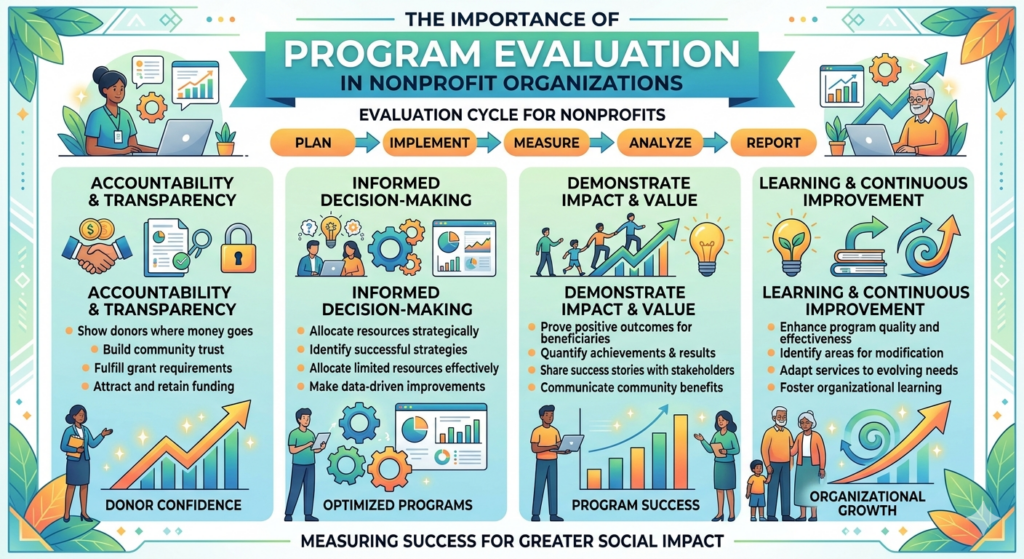
In an era of increasing accountability and competition for resources, nonprofit organizations face mounting pressure to demonstrate their value and impact. Program evaluation has emerged as what researchers describe as a “cornerstone” of nonprofit effectiveness, accountability, and sustainability (Kazanskaia, 2025). Far from being merely an administrative exercise, evaluation serves as a strategic tool that strengthens an organization’s ability to secure funding, build stakeholder relationships, and achieve lasting community impact.
The Strategic Value of Program Evaluation
Program evaluation provides nonprofits with systematic evidence of their outcomes and effectiveness. According to Kazanskaia (2025), evaluation frameworks and tools allow organizations to meet the growing demand from donors, governments, and communities for measurable impact and rigorous evidence. This shift toward evidence-based philanthropy means that evaluation is no longer optional—it’s a fundamental requirement for organizational legitimacy and stakeholder confidence.
National survey research confirms that nonprofits adopt evaluation for dual purposes: to improve program effectiveness and to enhance legitimacy with funders and the public (Mitchell & Berlan, 2016). This dual function positions evaluation as both an internal improvement tool and an external communication strategy.
How Evaluation Strengthens Core Funding Functions
Fundraising: Evaluation directly strengthens fundraising efforts by providing concrete evidence of outcomes and cost-effective impact. Kazanskaia (2025) notes that such evidence makes a stronger case for support and helps organizations avoid resource misallocation. When nonprofits can demonstrate measurable results, they give potential supporters confidence that their contributions will create meaningful change.
Grant Writing: In the competitive world of grant funding, clear objectives, indicators, and outcome data are essential. Evaluation tools—including logic models, SMART goals, and key performance indicators (KPIs)—help organizations align their proposals with funder requirements and demonstrate credibility (Kazanskaia, 2025). Grant makers increasingly require robust evaluation plans, and organizations that present well-designed evaluation frameworks signal professionalism and strategic thinking.
Donor Relations: Evaluation builds and maintains donor confidence by demonstrating measurable results, accountability, and a commitment to learning (Kazanskaia, 2025; Mitchell & Berlan, 2016). When evaluation is embedded in organizational culture and used for continuous improvement, it signals seriousness to funders (Benjamin et al., 2022). Clear findings, concise reporting, and transparent use of results help maintain trust and strengthen long-term donor relationships (Kazanskaia, 2025).
The Case for Starting Early
While evaluation can be introduced at any stage, research strongly supports integrating it from a program’s inception. Formative and process evaluation during program design and early implementation allow organizations to clarify needs, refine logic models, and detect implementation or theory failures before they become costly (Kazanskaia, 2025; Espinosa et al., 2022).
Early adoption of SMART objectives, KPIs, and monitoring systems creates baselines that make later impact evidence far more persuasive for funders (Kazanskaia, 2025). By integrating evaluation “into program cycles” from the outset, organizations support adaptive management, enable more efficient resource allocation, and build stronger cases for sustainability and scale-up (Kazanskaia, 2025). Starting early also cultivates an organizational culture of learning where data-driven decision-making becomes second nature.
Why It’s Never Too Late to Begin
Organizations without formal evaluation should take heart: research emphasizes that evaluation is both retrospective and forward-looking. Even established programs can use evaluation to diagnose problems, document results, and guide redesign (Kazanskaia, 2025; Fine et al., 2000; Espinosa et al., 2022).
Process and summative evaluations help identify implementation failures, improve program performance, and generate credible evidence for future fundraising and grant applications, even when no formal evaluation existed before (Kazanskaia, 2025; Fine et al., 2000). Studies demonstrate that when nonprofits start treating findings as inputs to continuous improvement—regardless of program age—they enhance learning, accountability, and long-term community benefit (Kazanskaia, 2025).
The key is commitment to using evaluation findings constructively, not simply collecting data to satisfy external requirements.
Building an Evaluation Culture
The most successful nonprofits view evaluation not as a compliance burden but as a strategic asset. Benjamin, Ebrahim, and Gugerty (2022) emphasize that embedding evaluation into organizational culture—where it informs strategy, program design, and communication—maximizes its value. This requires leadership commitment, staff capacity building, and integration of evaluation into regular planning and decision-making processes.
Conclusion
Program evaluation stands as a critical pillar of nonprofit success in the 21st century. It provides the evidence base necessary to secure funding, the insights needed to improve programs, and the accountability that builds stakeholder trust. Whether integrated from a program’s inception or introduced to mature initiatives, evaluation empowers nonprofits to demonstrate their value, learn from experience, and maximize their impact.
For nonprofit leaders, the message is clear: if you haven’t started evaluating your programs, begin today. Your organization’s future—and the communities you serve—depend on your ability to demonstrate and improve your impact through rigorous, thoughtful program evaluation.
References
Benjamin, L., Ebrahim, A., & Gugerty, M. (2022). Nonprofit Organizations and the Evaluation of Social Impact: A Research Program to Advance Theory and Practice. Nonprofit and Voluntary Sector Quarterly, 52, 313S-352S.
Espinosa, M., Richardson, M., DeMasters, C., Jones, J., & Wiley, K. (2022). Conducting a Process Evaluation in Nonprofit and Governmental Programs. EDIS.
Fine, A., Thayer, C., & Coghlan, A. (2000). Program Evaluation Practice in the Nonprofit Sector. Nonprofit Management and Leadership, 10, 331-339.
Kazanskaia, A. (2025). Multiple works. NEYA Global Journal of Non-Profit Studies.
Mitchell, G., & Berlan, D. (2016). Evaluation and Evaluative Rigor in the Nonprofit Sector. Nonprofit Management and Leadership, 27, 237-250.