
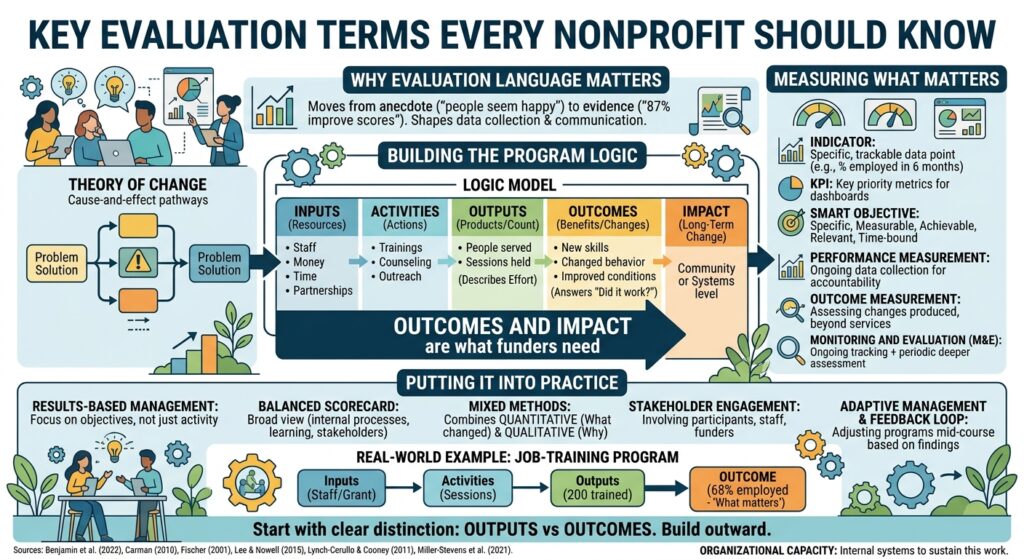
Nonprofits are under constant pressure to prove they’re making a difference — to funders, boards, communities, and themselves. But “proving impact” isn’t one task; it’s a vocabulary of interconnected concepts, and knowing that vocabulary is often the difference between a program that just runs and one that demonstrably works. Below is a practical guide to the terms that matter most.
Why Evaluation Language Matters
Evaluation is the systematic gathering of information about a program to judge its worth, inform decisions, and improve results. It’s what moves organizations from anecdote (“people seem happy with our services”) to evidence (“87% of participants improved literacy scores”). Getting the language right isn’t academic — it shapes what data you collect, how you talk to funders, and how you improve programs in real time.
Building the Program Logic
Theory of Change is the starting point: an explicit statement of how your intervention is expected to address a problem through cause-and-effect pathways. It forces staff and funders to test whether the underlying logic actually makes sense before anyone measures anything.
Logic Model turns that theory into a structured map — linking inputs, activities, outputs, and outcomes (and often long-term impact). It’s the single most useful planning and communication tool in evaluation, and it works best when revisited with stakeholders over time rather than written once and shelved.
Within a logic model, four terms do the heavy lifting:
- Inputs — the resources you invest: staff, money, time, partnerships.
- Activities — what you actually do: trainings, counseling, outreach.
- Outputs — the direct products of those activities, usually a count (people served, sessions held). Useful for monitoring, but outputs alone don’t tell you whether anyone’s life changed.
- Outcomes — the actual benefits or changes participants experience: new skills, changed behavior, improved conditions. This is where “did it work?” gets answered.
- Impact — broader, longer-term change at the community or systems level, beyond any one participant.
A simple gut-check: if your report only lists outputs (“we held 40 workshops”), you’re describing effort, not effectiveness. Outcomes and impact are what funders — and your own strategy — actually need.
Measuring What Matters
Once the logic is clear, measurement concepts come into play:
- Indicator — a specific, trackable data point used to register change in an output, outcome, or impact (e.g., “% of participants employed within 6 months”).
- KPI (Key Performance Indicator) — a priority metric, the handful of indicators that matter most for dashboards and course correction.
- SMART Objective — a goal that’s specific, measurable, achievable, relevant, and time-bound. Vague goals produce vague evaluations; SMART objectives tell you exactly what data to collect.
- Performance Measurement — the ongoing collection of data against organizational objectives and mission — the routine tracking that supports accountability.
- Outcome Measurement — specifically assessing the changes a program produces, beyond simply counting services delivered. This is increasingly what funders expect to see.
- Monitoring and Evaluation (M&E) — the combined discipline of ongoing tracking (monitoring) plus periodic deeper assessment of results and meaning (evaluation).
Putting It Into Practice
A few frameworks and practices show up repeatedly in the literature:
- Results-Based Management organizes the whole operation around results and strategic objectives rather than activity for its own sake.
- Balanced Scorecard broadens the view beyond finances to include internal processes, stakeholders, and learning — useful because nonprofit success isn’t just about the budget.
- Mixed Methods combines quantitative data (the “what changed”) with qualitative data (the “why”) — often essential, since numbers alone rarely explain causation.
- Stakeholder Engagement — involving participants, staff, and funders in choosing indicators and interpreting findings — increases both the credibility and the actual usefulness of your results.
Downstream of all this sits Adaptive Management (adjusting programs mid-course based on findings) and the Feedback Loop (the structured process of feeding data back into decisions) — the practices that turn evaluation from a compliance exercise into continuous organizational learning. Organizational Capacity — the internal systems and expertise to actually do this work — determines whether any of it is sustainable.
A Real-World Example
Picture a nonprofit running a job-training program. Their inputs are staff, curriculum, and grant funding. Their activities are the training sessions themselves. Their outputs might be “200 people trained.” But their outcome — the number that actually matters to a funder — is “68% of graduates employed within 90 days.” Their theory of change explains why training should lead to employment; their logic model maps the whole chain; and their KPI dashboard tracks employment rate monthly, feeding into adaptive management decisions about curriculum tweaks.
The Bottom Line
The nonprofits that get the most value from evaluation aren’t the ones collecting the most data — they’re the ones using precise language to connect program logic, measurement, and decision-making. Start by making sure your team can clearly distinguish outputs from outcomes, and build outward from there.
Sources: Benjamin, Ebrahim & Gugerty (2022), Nonprofit and Voluntary Sector Quarterly; Carman (2010), Nonprofit and Voluntary Sector Quarterly; Fischer (2001), Families in Society; Lee & Nowell (2015), American Journal of Evaluation; Lynch-Cerullo & Cooney (2011), Administration in Social Work; Miller-Stevens et al. (2021), Voluntas.